
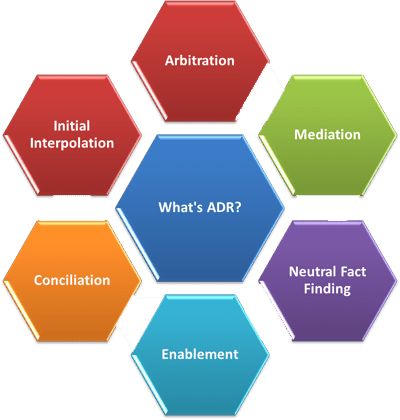
ADR is an umbrella term for a variety of methods which are used to resolve disputes without a traditional court proceeding. The term ADR includes mediation, conciliation and arbitration.
The most commonly referred expansion of ADR is “Alternative Dispute Resolution” and the scope of ADR includes finding the suitable remedial process for a particular dispute.
ADR includes negotiation where the parties to a dispute try to find a solution through dialogue with each other. However, not all parties to a dispute are able to or wish to negotiate with each other. At times the dispute is complex or emotionally charged they may not be in a position to negotiate. In such cases, they can engage a neutral to facilitate the dialogue and take the negotiation forward. In case dialogue is just not a possibility, the parties can choose to adjudicate the matter. Adjudication is what happens in court where a third party neutral decides the case in favor of one party after hearing the case of both the parties. Adjudication can be the traditional court process or arbitration which is an alternate to the court process. The choice of the appropriate process is a strategic decision and will depend on several factors.
In mediation, a neutral person called mediator, helps the parties try to reach a mutually acceptable resolution of the dispute. The mediator does not decide the case, but helps the parties communicate so they can try to resolve the dispute themselves. Mediation helps the parties maintain control over the dispute resolution process, uphold confidentiality and reach a speedy creative resolution without causing damage to their reputation. The only condition to mediation is the willingness of the parties to explore a solution through facilitated dialogue.
In certain jurisdictions, the terms mediation and conciliation are used interchangeably. However, in India, the two processes differ from each other technically and are prescribed at different stages of the dispute under the law. To know more about the difference between mediation and conciliation click here.
Arbitration more closely resembles traditional litigation such that neutral third party hears the disputants' arguments and imposes a final and binding decision that is enforceable by the courts. The difference is that in arbitration, the disputants mutually agree to the procedure, decide who will hear their case and the proceedings are typically less formal than in a court of law. One extremely important difference is that, unlike court decisions, arbitration offers almost no effective appeal process. Thus, when an arbitration decision is issued, the case is closed.
ADR is speedy and a cost-effective mechanism to resolve your dispute. If you would like to know more or would like a free consultation for understanding the most suitable method for your case, please write to us at info@mahacma.com. We will get back to you at the earliest.
All ADR processes are confidential. Information shared during a mediation proceeding cannot be disclosed to the other party or to the public and cannot be disclosed unless specifically permitted by the parties to the dispute.
Plot No.20, Shop no.9 and 10, Tirthraj
CHS, Behind Taluka Police Station,
Thana Naka Road, Panvel-410206,
Navi Mumbai, MH-India.
© 2022 All Rights Reserved. | Designed & maintained by arkloop solutions®